Tuesday, July 3, 2012
Mr.Fulcar NASA Space Camp Turkey: NASA Space Camp Turkey/Campamento Spacial NASA Tur...
Mr.Fulcar NASA Space Camp Turkey: NASA Space Camp Turkey/Campamento Spacial NASA Tur...: Welcome to my NASA/CAS Space Camp Turkey Blog! Bienvenidos a mi Blog de NASA/CAS Campamento Espacial Turquia! Hi my name is Obed Fulcar, bu...

Sunday, August 8, 2010
"Land Ho!Back to Dutch Harbor" Tierra a la Vista! De vuelta en Dutch
Teacher Log#10
NOAA Teacher at Sea:Obed Fulcar
NOAA Ship:Oscar Dyson
Mission:Summer Pollock Survey III
Geographic Area:Bering Sea, Alaska
Date: August 7, 2010
Today at 0600 am we finally made it back to Dutch Harbor. We arrived yesterday at the Island of Unalaska, where "Dutch" is located, but we were on the other side of the island, performing a Callibration (adjustment or fine tunning)
 of the acoustic sonnar. The ship came to a complete stop, and using shiny metal spheres, tied to lines that were dropped on both sides and under the ship, a "ping" or sound wave was done for fine adjustment. Callibrations are done several times a year in order to for the Sonar to work accurately. The crew took advantage of the ship been anchored to do some fishing for Halibut fish, but the catch was mostly of Cod fish. We also went out on a boat ride on the Peggy D speed boat, named after Oscar Dyson's wife, around nearby bays and inlets, w
 here we saw wildlife like sea otters
  and Puffin seabirds. Later on the day I was able to see where this sensitive piece of high technology was located when my good friend Robert, 2nd Engineer of the Oscar Dyson, gave a last tour of the "bowels of the beast". We went through several hatches and steps down to the lowest decks of the ship, where Robert explained the many pieces of heavy duty equipment and machinery that kept the ship on the move. First we put on Ear Muffs, because the noice level was too high (again safety first) and then we went to see the giant forward thruster in charge of mov
 ing the ship left or right, followed by even larger and louder machines: the ship's four Caterpillar Diesel Engin
 es. These enormous and heavy duty machines were connected to large generators that 24 hours a day supplied the electricity needed to run all of the ship's electronic systems. Next we checked out another room containing the large Wastewater Treatment tank, in charge of treating all the grey water or waste water from toilets, showers, and sinks of the ship. The tank utilized a biological process where bacteria broke down all the waste, then the resulting water was treated with w
 ith a combination of chemicals and Ultra Violet (UV) light to kill any germs before being safely released into the ocean. Finally he showed me
 the Disalinization Plant in charge of producing up to 1,500 gallons of freshwater by Evaporation or boiling of the saltwater and then through Condensation, where the water vapor is then separate from the salt and then be collected for human consumption. Also was able to see the darn Sonar acoustic antenna at the very bottom of the ship. I was amazed at the sustainability of the Oscar Dyson and how strict were NOAA's rules concerning reduction of pollution of the oceans. After thanking Robert and the crew it was time to say goodbye to the Oscar Dyson and to all my new friends that I made during the Summer P
 ollock cruise. I leave with a lot of memories, a wealth of experience and resources that I hope will have an enormous impact in my students when the new school year starts in September. I know it already have made an impact not only in my students, but in my family,friends and colleagues who had followed my adventures in my Blog these past 3 weeks. I wanted to thank CO Mike Halshyk, XO Sarah Duncan, and NOAA Corps Officers Ensign Russel Pate, Ensign Amber Payne and Ensign David Rodziewicz for their diligence in taking care of us, the scientitsts on board for their patience and wealth of knowledge, as well as all the crew of the Oscar Dyson for feeding me, teaching me about life at sea, and for bringings us back safe and in one piece. I also wanted to thank Elizabeth McMahon, Elizabeth Bullock , and Jennifer Hammond from NOAA for taking care of everything, and to my fellow Teacher at Sea Story Miller. You can check out her blog http://storymillernoaa2010.blogspot.com/
NOAA Teacher at Sea:Obed Fulcar
NOAA Ship:Oscar Dyson
Mission:Summer Pollock Survey III
Geographic Area:Bering Sea, Alaska
Date: August 7, 2010
Today at 0600 am
 we finally made it back to Dutch Harbor. We arrived yesterday at the Island of Unalaska, where "Dutch" is located, but we were on the other side of the island, performing a Callibration (adjustment or fine tunning)
 of the acoustic sonnar. The ship came to a complete stop, and using shiny metal spheres, tied to lines that were dropped on both sides and under the ship, a "ping" or sound wave was done for fine adjustment. Callibrations are done several times a year in order to for the Sonar to work accurately. The crew took advantage of the ship been anchored to do some fishing for Halibut fish, but the catch was mostly of Cod fish. We also went out on a boat ride on the Peggy D speed boat, named after Oscar Dyson's wife, around nearby bays and inlets, w
 here we saw wildlife like sea otters
  and Puffin seabirds. Later on the day I was able to see where this sensitive piece of high technology was located when my good friend Robert, 2nd Engineer of the Oscar Dyson, gave a last tour of the "bowels of the beast". We went through several hatches and steps down to the lowest decks of the ship, where Robert explained the many pieces of heavy duty equipment and machinery that kept the ship on the move. First we put on Ear Muffs, because the noice level was too high (again safety first) and then we went to see the giant forward thruster in charge of mov
 ing the ship left or right, followed by even larger and louder machines: the ship's four Caterpillar Diesel Engin
 es. These enormous and heavy duty machines were connected to large generators that 24 hours a day supplied the electricity needed to run all of the ship's electronic systems. Next we checked out another room containing the large Wastewater Treatment tank, in charge of treating all the grey water or waste water from toilets, showers, and sinks of the ship. The tank utilized a biological process where bacteria broke down all the waste, then the resulting water was treated with w
 ith a combination of chemicals and Ultra Violet (UV) light to kill any germs before being safely released into the ocean. Finally he showed me
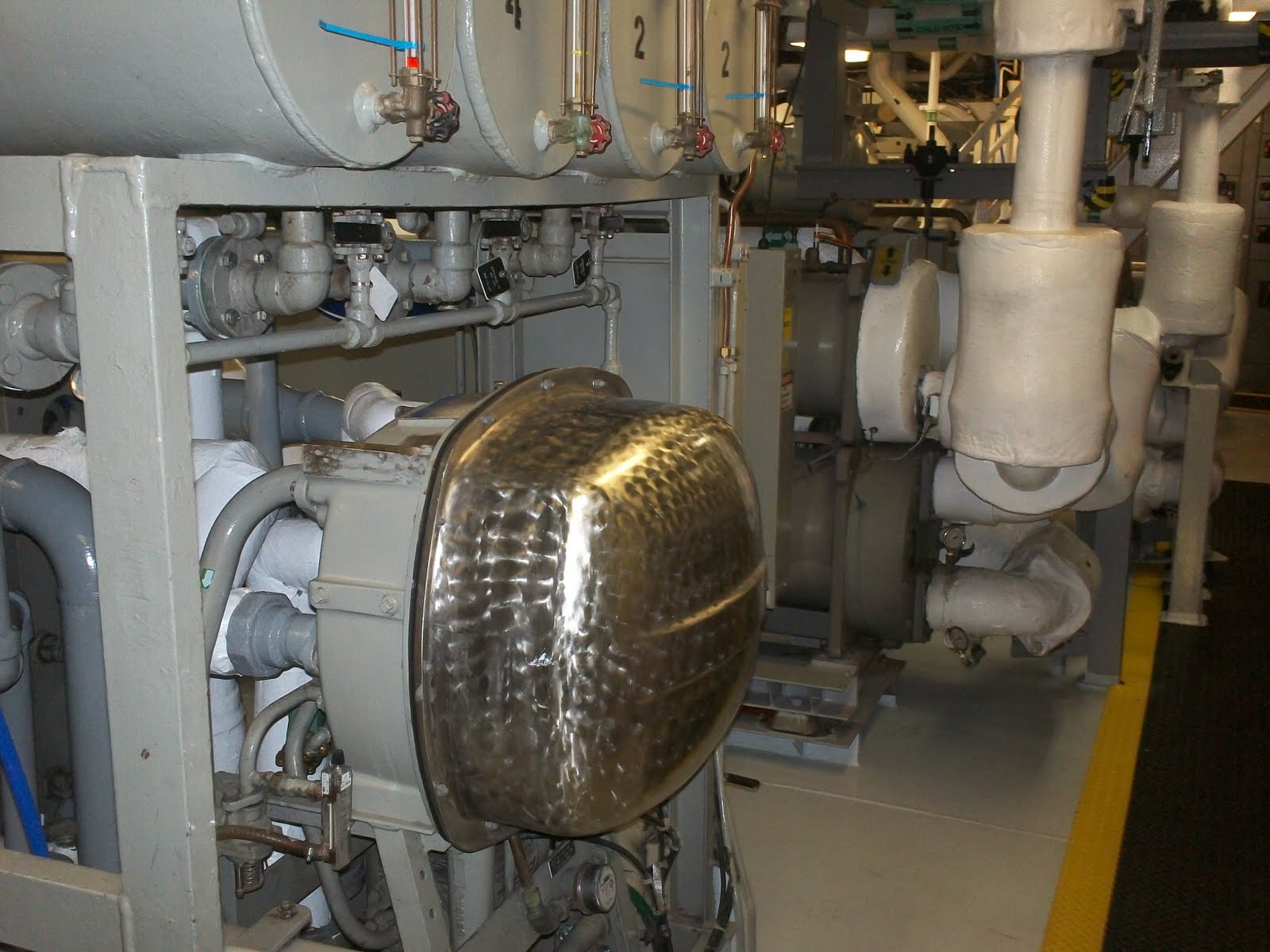 the Disalinization Plant in charge of producing up to 1,500 gallons of freshwater by Evaporation or boiling of the saltwater and then through Condensation, where the water vapor is then separate from the salt and then be collected for human consumption. Also was able to see the darn Sonar acoustic antenna at the very bottom of the ship. I was amazed at the sustainability of the Oscar Dyson and how strict were NOAA's rules concerning reduction of pollution of the oceans. After thanking Robert and the crew it was time to say goodbye to the Oscar Dyson and to all my new friends that I made during the Summer P
 ollock cruise. I leave with a lot of memories, a wealth of experience and resources that I hope will have an enormous impact in my students when the new school year starts in September. I know it already have made an impact not only in my students, but in my family,friends and colleagues who had followed my adventures in my Blog these past 3 weeks. I wanted to thank CO Mike Halshyk, XO Sarah Duncan, and NOAA Corps Officers Ensign Russel Pate, Ensign Amber Payne and Ensign David Rodziewicz for their diligence in taking care of us, the scientitsts on board for their patience and wealth of knowledge, as well as all the crew of the Oscar Dyson for feeding me, teaching me about life at sea, and for bringings us back safe and in one piece. I also wanted to thank Elizabeth McMahon, Elizabeth Bullock , and Jennifer Hammond from NOAA for taking care of everything, and to my fellow Teacher at Sea Story Miller. You can check out her blog http://storymillernoaa2010.blogspot.com/
Hoy temprano a las 0600 am horas finalmente llegamos de vuelta a Dutch Harbor! Desde el dia de ayer habiamos estado anclados en la isla de Unalaska, al extremo opuesto de Dutch Harbor. La tripulacion y los cientificos esta
 ban practicando una Calibracion del sonar acustico, usando unas esferas metalicas, con el fin de ajustar las lecturas de este sofisticado instrumento electronico. Estas esferas estaban atadas a unas cuerdas finas de un lado a otro del barco (de Babor a Estribor), y con un "ping" del sonar estas eran grabadas en el monitor. Tambien fuimos en un paseo por las bahias y ensenadas c
 ercanas en la lancha rapida "Peggy D" nombrada en honor a la esposa de Oscar Dyson, Estuvimos admirando el increible panorama de la isla de Unalaska y su vida silvestre como las Nutrias Marinas y las aves marinas Puffin. Luego en la tarde mi buen amigo
  Robert, 2do Ingeniero de maquinarias del Oscar Dyson, me dio un tour de la barriga del barco. Armados de linternas y de protectores de oido, debido al alto ruido de las maquinarias. Bajamos bajo cubierta por varias compuertas y escalinatas que nos llevaron primero a visitar el cuarto del Propulsor de proa, usado para darle vuelta al barco. Luego fuimos a ver los enormes Generadores de gasoil Caterpilar usados para producir la energia necesaria para mover todos los equipos electronicos abordo del Oscar Dyson 24 horas al dia. Despues fuimos a otro cuarto conteniendo el Tanque de Tratamiento de Aguas Negras de la nave donde toda el agua de desecho de inodo
 ros y lavaderos de cocina, utilizando un proceso biologico donde bacteria descompone el desecho en el agua. Despues el agua pasaba por una lampara de Rayos Ultravioleta para matar todo germen patogeno, para ser luego descargada inofensivamen
 te en el mar. Finalmente visitamos la maquinaria que mas me interesaba ver: la Planta Desalinizadora de Agua que estaba a cargo de producir 1,200 galones de agua potable usando agua salada del mar. Por medio de un proceso de Evapo
 racion la sal era separada del agua de mar, y por medio de Condensacion el agua potable es recuperada para consumo humano en el barco. Me sorprendio mucho la sostenibilidad del Oscar Dyson, donde los desechos son reciclados pues en NOAA son muy estrictos con que ninguna basura solida alcanze el mar, lo cual esta prohibido por ley. Es increible que todavia hoy en dia naves comerciales y cruceros de lujo lanzen sus desechos de aguas negras y basura al mar. Despues de darle las gracias a Robert llego la hora de decir adios al Oscar Dyson y a su tripulacion que fue mi hogar y mi familia por 3 semanas de mi vida en este verano 2010. Me marcho con muchos recuerdos y conocimientos que no solamente impactaran mis estudiantes en Septiembre sino que ya han hecho un impacto positivo. Le agradesco a todo el personal de NOAA, asi como al Oficial Comandante Mike Helshyck, Oficial Ejecutivo Sarah Duncan y demas oficiales, asi como a todo el personal de abordo por haberme adoptado y compartido tantas informaciones durante el Crucero de Pollock. Tambien le agradesco mucho a todos los cientificos abordo asi como a la Maestra en el Mar, mi colega educadora de Dutch Harbor Story Miller por su ayuda y consejos. Pueden tambien chequear su blog en http://storymillernoaa2010.blogspot.com/
Thursday, August 5, 2010
"Camera Trawl to ROV" De Camaras Aquaticas a Robots
TEACHER LOG#9
NOAA Teacher at Sea: Obed Fulcar
NOAA Ship:Oscar Dyson
Mission:Summer Pollock Survey III
Geographical Area:Bering Sea
Date:Friday, July 30, 2010
Weather from the Bridge:
Time:11:47 am
Latitude:58.47 North
Longitude:178 West
Wind Speed:2.9 knots
Wind Direction:270 West
Sea Temperature:9.7 C (49.46 F)
Air Temperature:7.2 C (44.96 F)
Barometric Pressure:1008 millibars
SCIENCE & TECHNOLOGY LOG:
During this cruise the tech crew has been very busy working on getting to work the prototype for a new Camera Trawl. This new camera array is designed to be deployed independently from the trawl and able to take pictures and footage of the fish down below. The pictures then can be analyzed to determine if the size of the Pollock is the rights one, thus reducing the need to launch the trawl net unnecessarily. So far the camera has not worked a s expected and the team has done countless adjustments to it. They suspect that there is a bug in the software causing the problems. This is an example of how technology has to be tested many times in labs and in the field in order to become available for use. I always tell students in the class that many of the technology that we use today, such as cell phones, laptop computers, flat screen TVs, and even microwaves, we owe it to the scientists and technicians that developed them originally for the astronauts in the aerospace program.
PERSONAL LOG:
Coming to the ship on this cruise I was very excited because I had seen on the Oscar Dyson website pictures of an ROV (Remote Operated Vehicle) underwater robot been deployed, and was really looking forward to see it in action. I was a little disappointed when I learned that the ROV was not on board, because it was part of a test done the year before. This gave me the inspiration to implement in September a technology project i have been meaning to do with my students:to build a student ROV, using NOAA's "Rov in a bucket" activity. The students will incorporate STEM (Science, Technology, Math, and Engineering) as part of the process of learning to design, create, and build the ROV. This project will be built during/after school and once assembled and operational it can be used to broadcast pictures or even underwater footage. We could use it during our community events on the Harlem River to create awareness amongst residents that the river is cleaner than ever, and that many aquatic species inhabit the waters.
"Camaras Aquaticas a Robot Sumergibles"
Durante todo el crucero los tecnicos de la nave han estado muy ocupados en hacer funcionar una Camara Sumergible, que a diferencia de la Camara de Arrastre, que se lanza junto a la red para tomar fotos, esta tomaria fotos y video de los peces a diferentes profundidades sin necesidad de tener que lanzar la red de arrastre. El beneficio seria que esta camara usaria un programa especial que permitiria analizar en tiempo real las dimensiones de el tipo de pez expecifico. El personal tecnico realizo incontables ajustes, sin ningun exito hasta el momento. Se cree que es un malfuncionamiento del program de computadora. Este es un ejemplo de como la tecnologia es probada y examinada tanto en el laboratorio com en el campo antes de estar disponible al publico. Siempre le digo a los estudiantes que mucha de la tecnologia que usamos como el telefono celular, el microndas, y el ordenador laptop, han sido fruto de la investigacion del program aeroespacial para los astronautas. Antes de yo venir al Oscar Dyson estaba muy entusiasmado en poder ver en accion al robot sumergible ROV, o Vehiculo de Control Remoto, que yo habia visto en fotos del website. El desencanto que recibi cuando me dijeron que el ROV no estaba abordo, y que las fotos eran de una vieja mision, no fue poco. Esto me ha inspirado a en Septiembre a hacer un proyecto de STEM (Ciencia, Tecnologia, Ingenieria y Matematicas), donde los estudiantes armaran un ROV sumergible. ellos usaran estrategias similares a las que usan los technicos y cientificos en la creacion de un robot. El ROV tendra la capacidad de tomar fotos y video bajo el agua, y posiblemente ser usado en exhibiciones ambientales de la comunidad.
NOAA Teacher at Sea: Obed Fulcar
NOAA Ship:Oscar Dyson
Mission:Summer Pollock Survey III
Geographical Area:Bering Sea
Date:Friday, July 30, 2010
Weather from the Bridge:
Time:11:47 am
Latitude:58.47 North
Longitude:178 West
Wind Speed:2.9 knots
Wind Direction:270 West
Sea Temperature:9.7 C (49.46 F)
Air Temperature:7.2 C (44.96 F)
Barometric Pressure:1008 millibars
SCIENCE & TECHNOLOGY LOG:

During this cruise the tech crew has been very busy working on getting to work the prototype for a new Camera Trawl. This new camera array is designed to be deployed independently from the trawl and able to take pictures and footage of the fish down below. The pictures then can be analyzed to determine if the size of the Pollock is the rights one, thus reducing the need to launch the trawl net unnecessarily. So far the camera has not worked a
 s expected and the team has done countless adjustments to it. They suspect that there is a bug in the software causing the problems. This is an example of how technology has to be tested many times in labs and in the field in order to become available for use. I always tell students in the class that many of the technology that we use today, such as cell phones, laptop computers, flat screen TVs, and even microwaves, we owe it to the scientists and technicians that developed them originally for the astronauts in the aerospace program.
PERSONAL LOG:
Coming to the ship on this cruise I was very excited because I had seen on the Oscar Dyson website pictures of an ROV (Remote Operated Vehicle) underwater robot been deployed, and was really looking forward to see it in action. I was a little disappointed when I learned that the ROV was not on board, because it was part of a test done the year before. This gave me the inspiration to implement in September a technology project i have been meaning to do with my students:to build a student ROV, using NOAA's "Rov in a bucket" activity. The students will incorporate STEM (Science, Technology, Math, and Engineering) as part of the process of learning to design, create, and build the ROV. This project will be built during/after school and once assembled and operational it can be used to broadcast pictures or even underwater footage. We could use it during our community events on the Harlem River to create awareness amongst residents that the river is cleaner than ever, and that many aquatic species inhabit the waters.
"Camaras Aquaticas a Robot Sumergibles"
Durante todo el crucero los tecnicos de la nave han estado muy ocupados en hacer funcionar una Camara Sumergible, que a diferencia de la Camara de Arrastre, que se lanza junto a la red para tomar fotos, esta tomaria fotos y video de los peces a diferentes profundidades sin necesidad de tener que lanzar la red de arrastre. El beneficio seria que esta camara usaria un programa especial que permitiria analizar en tiempo real las dimensiones de el tipo de pez expecifico. El personal tecnico realizo incontables ajustes, sin ningun exito hasta el momento. Se cree que es un malfuncionamiento del program de computadora. Este es un ejemplo de como la tecnologia es probada y examinada tanto en el laboratorio com en el campo antes de estar disponible al publico. Siempre le digo a los estudiantes que mucha de la tecnologia que usamos como el telefono celular, el microndas, y el ordenador laptop, han sido fruto de la investigacion del program aeroespacial para los astronautas. Antes de yo venir al Oscar Dyson estaba muy entusiasmado en poder ver en accion al robot sumergible ROV, o Vehiculo de Control Remoto, que yo habia visto en fotos del website. El desencanto que recibi cuando me dijeron que el ROV no estaba abordo, y que las fotos eran de una vieja mision, no fue poco. Esto me ha inspirado a en Septiembre a hacer un proyecto de STEM (Ciencia, Tecnologia, Ingenieria y Matematicas), donde los estudiantes armaran un ROV sumergible. ellos usaran estrategias similares a las que usan los technicos y cientificos en la creacion de un robot. El ROV tendra la capacidad de tomar fotos y video bajo el agua, y posiblemente ser usado en exhibiciones ambientales de la comunidad.
Wednesday, August 4, 2010
"An International Collaboration" Una Cooperacion Internacional
TEACHER LOG#8
NOAA Teacher at Sea: Obed Fulcar
NOAA SHIP:Oscar Dyson
Mission:Summer Pollock Survey III
Geographical Area:Bering Sea
Date:Thursday, July 29, 2010
Weather from the Bridge:
Time:05:56 am
Latitude:61.05 N
Longitude:178.51 W
Wind Direction: 300 N
Wind Speed:12.5 knots
Sea Temperature:8.0 C (46.4 F)
Air Temperature:9.5 C (49.10 F)
Barometric Pressure:1008 mb
Foggy Skies
SCIENCE & TECHNOLOGY LOG:
Wednesday, July 28: after a cloudy and foggy day, (Picture of a ship on Russian waters)the weather finally changed and the afternoon became sunny and clear, very pleasant to be on deck. For the past several days we have been navigating in the Russian territorial waters of the Bering Sea, for which we have permission, as testified by a letter in Russian posted on the bridge. Alaska used to be a possession of Russia, until October 18, 1867 it became a territory of the United States. We can still see Russian Orthodox churches still open today in some islands of Alaska. Pretty soon the direction of the current transect or line course, will bring us as close as 12.6 miles from land. At one point we were close to 14 miles off Cape Navarin, but there was fog in the distance and without notice the beautiful afternoon disappeared and I was not able to see Russia. Later on during the afternoon trawl, while sorting the catch of Pollock, a big fish came out on the conveyor:it was a Chum Salmon or Dog fish" said Dr. Mikhail Stepanenko, a Russian scientists working w ith his colleague Elena Gritsay, from the Vladivostok School of Fisheries, collaborating in the Walleye Pollock survey.to help improve the management of Russian fisheries. According to Mikhail it was most likely that the chum salmon had been born in Japanese waters, and had migrated to spawn near Cape Navarin. After I measured it then I dissected the fish to see if it was male or female. The organs were slightly different in size and location than the Pollock, but basically the same. The pillora seca was very large, engulfing the long stomach and liver, and the kidneys were right behind the swim bladder. The presence of an organ called gonads or testes confirmed that it was a male. I tried to locate the otolith, for my classroom collection bu could not locate it. There was also a very interesting fish in the catch: a Toad Lump sucker, a very cute looking fish
 that resembled a blow fish because it was swollen like a balloon. It had a suction orifice in the underbelly too.
Animals Seen Today:
Chum Salmon (Oncorhynchus keta), Toad Lump sucker (Eumicrotemus phrynoides)
Vocabulary:
Cape Navarin, Gonads, Pillora Seca, Orthodox, Swim Bladder
PERSONAL LOG:
I noticed that in this cruise there is an atmosphere of professional collaboration between scientists and the crew. There is also a sense of collegiate amongst all the scientists working on board the Oscar Dyson. The Pollock Survey is the primary mission, but there are other parallel missions going on: the seabird survey, done by Marty and Liz, and the marine mammal survey, done by Patty, Paula, and Ernesto. To do research on the Bering Sea is very challenging due to the remote locations, and the storms, winds, large waves, and extreme weather. The need for oceangoing vessels to work in these extreme conditions makes it very expensive, so when ships like the Oscar Dyson are deployed, different missions are planned to "piggyback" along. I was very impressed by the international collaboration in the mission, with the two Russian scientists on board conducting research on the Pollock fisheries, since part of the transects done by the Oscar Dyson covered Russian territorial waters as well. The fact the one Mexican scientist, a Filipino cook, and a Dominican teacher at sea were part of this cruise added more countries to the mission. Just like us, fish travel in different waters, local and international, and they too are citizens of the world's oceans. I wanted to commend NOAA's administration for providing career opportunities to minorities, Latinos, and women to work as scientists, technicians, Corps officers, and crew.
"Una Cooperacion Internacional" Durante todo el trayecto de este crucero de Monitoreo del Pollock he notado un ambiente de profesionalismo entre el personal cientifico y la tripulacion, asi tambien como un ambiente de colegiatura enter los diferentes cientificos trabajando a bordo del Oscar Dyson. La mision primaria es el Monitoreo del Pollock, pero a su vez hay otras misiones paralelas a la mision principal, como son el Estudio de las Aves Marinas,por Liz y Marty, asi como el Estudio de los Mamiferos Marinos, por Patty,Paula, y Ernesto. Hay que entender que hacer investigacion cientifica en el Estrecho de Bering es una tarea logistica complicada por lo remoto del lugar, lo extremo del clima, asi como gigantescas olas. Solo se pueden usar barcos de navegacion oceanica que son muy costosos, por lo que cuando embarcaciones como el Oscar Dyson son lanzadas, multiples misiones son planeadas al mismo tiempo tambien. Me llamo mucho la atencion la cooperacion internacional, especialmente los dos cientificos rusos a bordo, que tambien relizaban estudios del Pollock, lo cual tiene mucho sentido, debido a que gran parte de la investigacion cubria aguas territoriales rusas. El hecho de que un biologo Mexicano, un filipino (Ray el cocinero), y un Maestro en el Mar dominicano tambien forman parte de este crucero le agregan mas paises a la mision. Yo quiero felicitar a la administracion de NOAA por proveer oportunidades de carreras profesionales tanto a minorias, como a Latinos, y a mujeres para trabajar como cientificos, tecnicos, Cuerpo de Oficiales o como tripulantes. Yo creo que esto es un gran incentivo para que mas jovenes estudiantes de escuela intermedia y secundaria puedan perseguir carreras profesioanles en Conservacion Ambiental.
NOAA Teacher at Sea: Obed Fulcar
NOAA SHIP:Oscar Dyson
Mission:Summer Pollock Survey III
Geographical Area:Bering Sea
Date:Thursday, July 29, 2010
Weather from the Bridge:
Time:05:56 am

Latitude:61.05 N
Longitude:178.51 W
Wind Direction: 300 N
Wind Speed:12.5 knots
Sea Temperature:8.0 C (46.4 F)
Air Temperature:9.5 C (49.10 F)
Barometric Pressure:1008 mb
Foggy Skies
SCIENCE & TECHNOLOGY LOG:
Wednesday, July 28: after a cloudy and foggy day, (Picture of a ship on Russian waters)the weather finally changed and the afternoon became sunny and clear, very pleasant to be on deck. For the past several days we have been navigating in the Russian territorial waters of the Bering Sea, for which we have permission, as testified by a letter in Russian posted on the bridge. Alaska used to be a possession of Russia, until October 18, 1867 it became a territory of the United States. We can still see Russian Orthodox churches still open today in some islands of Alaska. Pretty soon the direction of the current transect or line course, will bring us as close as 12.6 miles from land. At one point we were close to 14 miles off Cape Navarin, but there was fog in the distance and without notice the beautiful afternoon disappeared and I was not able to see Russia. Later on during the afternoon trawl, while sorting the catch of Pollock, a big fish came out on the conveyor:it was a Chum Salmon or Dog fish" said Dr. Mikhail Stepanenko, a Russian scientists working w
 ith his colleague Elena Gritsay, from the Vladivostok School of Fisheries, collaborating in the Walleye Pollock survey.to help improve the management of Russian fisheries. According to Mikhail it was most likely that the chum salmon had been born in Japanese waters, and had migrated to spawn near Cape Navarin. After I measured it then I dissected the fish to see if it was male or female. The organs were slightly different in size and location than the Pollock, but basically the same. The pillora seca was very large, engulfing the long stomach and liver, and the kidneys were right behind the swim bladder. The presence of an organ called gonads or testes confirmed that it was a male. I tried to locate the otolith, for my classroom collection bu could not locate it. There was also a very interesting fish in the catch: a Toad Lump sucker, a very cute looking fish
 that resembled a blow fish because it was swollen like a balloon. It had a suction orifice in the underbelly too.
Animals Seen Today:
Chum Salmon (Oncorhynchus keta), Toad Lump sucker (Eumicrotemus phrynoides)
Vocabulary:
Cape Navarin, Gonads, Pillora Seca, Orthodox, Swim Bladder
PERSONAL LOG:
I noticed that in this cruise there is an atmosphere of professional collaboration between scientists and the crew. There is also a sense of collegiate amongst all the scientists working on board the Oscar Dyson. The Pollock Survey is the primary mission, but there are other parallel missions going on: the seabird survey, done by Marty and Liz, and the marine mammal survey, done by Patty, Paula, and Ernesto. To do research on the Bering Sea is very challenging due to the remote locations, and the storms, winds, large waves, and extreme weather. The need for oceangoing vessels to work in these extreme conditions makes it very expensive, so when ships like the Oscar Dyson are deployed, different missions are planned to "piggyback" along. I was very impressed by the international collaboration in the mission, with the two Russian scientists on board conducting research on the Pollock fisheries, since part of the transects done by the Oscar Dyson covered Russian territorial waters as well. The fact the one Mexican scientist, a Filipino cook, and a Dominican teacher at sea were part of this cruise added more countries to the mission. Just like us, fish travel in different waters, local and international, and they too are citizens of the world's oceans. I wanted to commend NOAA's administration for providing career opportunities to minorities, Latinos, and women to work as scientists, technicians, Corps officers, and crew.
"Una Cooperacion Internacional" Durante todo el trayecto de este crucero de Monitoreo del Pollock he notado un ambiente de profesionalismo entre el personal cientifico y la tripulacion, asi tambien como un ambiente de colegiatura enter los diferentes cientificos trabajando a bordo del Oscar Dyson. La mision primaria es el Monitoreo del Pollock, pero a su vez hay otras misiones paralelas a la mision principal, como son el Estudio de las Aves Marinas,por Liz y Marty, asi como el Estudio de los Mamiferos Marinos, por Patty,Paula, y Ernesto. Hay que entender que hacer investigacion cientifica en el Estrecho de Bering es una tarea logistica complicada por lo remoto del lugar, lo extremo del clima, asi como gigantescas olas. Solo se pueden usar barcos de navegacion oceanica que son muy costosos, por lo que cuando embarcaciones como el Oscar Dyson son lanzadas, multiples misiones son planeadas al mismo tiempo tambien. Me llamo mucho la atencion la cooperacion internacional, especialmente los dos cientificos rusos a bordo, que tambien relizaban estudios del Pollock, lo cual tiene mucho sentido, debido a que gran parte de la investigacion cubria aguas territoriales rusas. El hecho de que un biologo Mexicano, un filipino (Ray el cocinero), y un Maestro en el Mar dominicano tambien forman parte de este crucero le agregan mas paises a la mision. Yo quiero felicitar a la administracion de NOAA por proveer oportunidades de carreras profesionales tanto a minorias, como a Latinos, y a mujeres para trabajar como cientificos, tecnicos, Cuerpo de Oficiales o como tripulantes. Yo creo que esto es un gran incentivo para que mas jovenes estudiantes de escuela intermedia y secundaria puedan perseguir carreras profesioanles en Conservacion Ambiental.
"Trawling in the High Seas" Echando La Red en Alta Mar
TEACHER LOG#7
NOAA Teacher at Sea: Obed Fulcar
NOAA Ship: Oscar Dyson
Mission:Summer Pollock Survey III
Geographical Area:Bering Sea
Date:Wednesday, July 28, 2010
Weather from the Bridge:
Time:04:42 am
Latitude:61.04 North
Longitude:178.06 West
Wind Speed:10.74 knots
Wind Direction:50 degrees North
Sea Temperature:8.99 C (48.02 F)
Air Temperature:8.2 C (46.76 F)
Barometric Pressure: 1010.1 millibars
Cloudy Skies
SCIENCE AND TECHNOLOGY LOG:

Friday, July 23: The Walleye Pollock survey has been conducted since 1979, every summer by MACE (Midwater Assessment and Conservation Engineering) part of the Alaska Fisheries Science center (AFSC). The sea was quite calm compared to the last days, giving us a break from sea sickness. The other day I missed the trawl, but I will not today. As soon as we saw the fish in the Acoustic sonar screens I knew it was trawling time, so I ran up to the bridge to witness the whole thing. The started deploying an Aleutian Wind Trawler or AWT net that was attached to a giant winch with huge ropes and chains. The long net had a front orange section with smaller openings compared to the back. I was invited to come to deck by deckhand Buddy Gould. He is a veteran New england fisherman from Rhode Island, now living in Florida. I asked permission fro m Commanding Officer CO Mike Hashlyck , and went on deck wearing a PFD, and a hard hat. After trawling the net behind the ship for what felt like an eternity, it was finally hauled back, the catch of Pollock was then spilled into a box leading to the wet lab for slicing and dicing. I went inside an put on rain boots, a plastic jacket and a jumpsuit, plus elbow high plastic glove and got down to slice and measure Pollock. While sorting out the fish we found a Pacific Flounder and a Rock sole fish, both flat bottom fish. For the next several days while conducting the survey, I kept dissecting the content of the stomachs of everal fish to find out what they have been eating. I learned that the main diet of Pollock was made up of animal plankton called Euphasiids, also known as krill. These small organisms are arthropods or segmented invertebr
 ates (without internal skeleton), and just like shrimps, and crabs, their bodies are covered by an exoskeleton or shell, with paired antennae, pincers, and legs. They were present in the stomach of all the specimens in a pink color mass. There was one large maturity level 4/5 Pollock that when I opened its stomach, a large Northen Pacific shrimp came out of it. Then in later catches I observed that all the stomachs were very dark-blue lo
 oking. When I opened the stomach of one fish there was a dark purple mass of another arthropod called Pelagic amphipods, or sea fleas. Amphipods swim drifting in the water column and are larger than euphasiids or krill, wich instead formed massive swarms swimming at great depths by day but heading to suface by night. I was able to witness this pattern when once the echogram from the acoustic radar showed a swarm of krill drifting from the surface to the bottom as the sun was rising.
NOAA Teacher at Sea: Obed Fulcar
NOAA Ship: Oscar Dyson
Mission:Summer Pollock Survey III
Geographical Area:Bering Sea
Date:Wednesday, July 28, 2010
Weather from the Bridge:
Time:04:42 am
Latitude:61.04 North
Longitude:178.06 West
Wind Speed:10.74 knots
Wind Direction:50 degrees North
Sea Temperature:8.99 C (48.02 F)
Air Temperature:8.2 C (46.76 F)
Barometric Pressure: 1010.1 millibars
Cloudy Skies
SCIENCE AND TECHNOLOGY LOG:

Friday, July 23: The Walleye Pollock survey has been conducted since 1979, every summer by MACE (Midwater Assessment and Conservation Engineering) part of the Alaska Fisheries Science center (AFSC). The sea was quite calm compared to the last days, giving us a break from sea sickness. The other day I missed the trawl, but I will not today. As soon as we saw the fish in the Acoustic sonar screens I knew it was trawling time, so I ran up to the bridge to witness the whole thing. The started deploying an Aleutian Wind Trawler or AWT net that was attached to a giant winch with huge ropes and chains. The long net had a front orange section with smaller openings compared to the back. I was invited to come to deck by deckhand Buddy Gould. He is a veteran New england fisherman from Rhode Island, now living in Florida. I asked permission fro
 m Commanding Officer CO Mike Hashlyck , and went on deck wearing a PFD, and a hard hat. After trawling the net behind the ship for what felt like an eternity, it was finally hauled back, the catch of Pollock was then spilled into a box leading to the wet lab for slicing and dicing. I went inside an put on rain boots, a plastic jacket and a jumpsuit, plus elbow high plastic glove and got down to slice and measure Pollock. While sorting out the fish we found a Pacific Flounder and a Rock sole fish, both flat bottom fish. For the next several days while conducting the survey, I kept dissecting the content of the stomachs of everal fish to find out what they have been eating. I learned that the main diet of Pollock was made up of animal plankton called Euphasiids, also known as krill. These small organisms are arthropods or segmented invertebr
 ates (without internal skeleton), and just like shrimps, and crabs, their bodies are covered by an exoskeleton or shell, with paired antennae, pincers, and legs. They were present in the stomach of all the specimens in a pink color mass. There was one large maturity level 4/5 Pollock that when I opened its stomach, a large Northen Pacific shrimp came out of it. Then in later catches I observed that all the stomachs were very dark-blue lo
 oking. When I opened the stomach of one fish there was a dark purple mass of another arthropod called Pelagic amphipods, or sea fleas. Amphipods swim drifting in the water column and are larger than euphasiids or krill, wich instead formed massive swarms swimming at great depths by day but heading to suface by night. I was able to witness this pattern when once the echogram from the acoustic radar showed a swarm of krill drifting from the surface to the bottom as the sun was rising.
Animal Species observed:
Arrowtooth Flounder (Atheresthes stomias), Northern Rock Sole fish (Lepidopsetta polyxystra), Northern Pacifi Shrimp
VOCABULARY: Amphipods, Arthropods, Ecograms, Euphasiids, Exoskeleton, Invertebrates, Krill
PERSONAL LOG:I realized that this tiny organism (the krill) is crucial for the survival not only of many animals in the ocean, but ultimately of us humans. We have historically harvested the rich waters of the Bering Sea for food, and most recently as a source of cheap protein to feed cattle and even pets. Disasters such as the recent massive oil spill from the tracgic explosion of the Deep Horizon oil platform, own by giant multinational BP, and the Exxon Valdez oil spill in Alaska during the 80's are examples of how fragile the marine ecosystem is. But the number one threat to ocean fisheries is actually overfishing exploitation of the ocean resources. I heard stories about the foreign fleets that come to Russian waters and overfish with impunity, while at the same time processing, canning, and packing all their catch aboard their ships, taking it all back to their countries, without sharing any jobs opportunities with the local communities. Historically local fishing fleets have fished sustainably, bringing back to local ports the catch, allowing canneries, and fish markets to also benefit from it. We have to spread the word about this injustice and begin to question our own habits, to see what can we change in our consumption that will have a positive impact in this urgent matter.
"Echando la Red en Alta Mar" El mareo de ayer no me permitio participar en la pesca del Pollock, pero no hoy! Tan pronto me entere, subi al puente para observar lo todo. Mi buen amigo del personal de cubierta, Buddy Gould pescador de Rhode Island radicado en la Florida, me invito a bajar a cubierta. Despues de ahbe asegurado permiso del Oficial Comandante Mike Holshyck, baje a la cubierta con chaleco flotador y casco de seguridad a cuestas. La anaranjada Red de Arrastre fue lanzada al mar por unos gigantescos rollos de cables y cadenas pesadas. Luego de lo que parecio una eternidad, la red fue traida a bordo y la pesca fue depositada en una rampa en la cubierta por una grua pesada. Yo fui adentro rapidamente y me vesti con guantes, poncho, pantalones, y botas de plastico y me puse las manos a la obra: a picar los pescados! Durante el proceso note que los estomagos de los pescados cambiaron de color rosado a color purpura. El contenido de los estomagos incluia un plankton-animal llamado Euphasiid o Krill, un artropodo (invertebrados parecidos al camaron y el cangrejo), asi como otro llamado Amphipods, los cuales constituyen la dieta primaria de especies de peces como el Pollock, y el Salmon, asi como de las ballenas jorobadas. El krill no solo es primordial para estas especies marinas sino para la raza humana, que depende de las reservas alimenticias del Estrecho de Bering como gran fuente de proteina. Es lamentable que este fragil recurso natural no sea celosamente cuidado, cuando vemos como el desastre del derrame de la Plataforma Petrolera Deep Horizon en el Golfo de Mexico, y en los 80's del Exxon Valdez en Alaska, puede facilmente hacer desaparecer la pesqueria. Pero el enemigo numero uno de este recurso natural es realmente la pesca desmedida por parte de flotas pequeras extranjeras que viene a las aguas del Estrecho de Bering, pescando indiscriminadamente. Estos barcos no solo pescan, si no que procesan y empaquetan todo a bordo sin dejar si quiera oportunidad a las comunidades locales de participar del beneficio sostenido. Tenemos que hacer eco de esta injusticia y autoanalizar nuestros habitos a fin de ver que podemos cambiar para poder hacer un impacto positivo.
Monday, August 2, 2010
"Walleye Pollock Survey"Monitoreo del Bacallao
TEACHER LOG#6
NOAA Teacher at Sea: Obed Fulcar
NOAA Ship:Oscar Dyson
Mission:Summer Pollock survey III
Geograpical Area:Bering Sea, Alaska
Date:Tuesday, July 27,2010
Weather from the Bridge:
Time:05:26 am
Latitude:59.27 N
Longitude:176.58 W
Wind Speed:11.8 knots
Wind Direction:219 degrees W
Sea Temperature:9.4 C (48.92 F)
Air Temperature:8.27 C (46.88 F)
Barometric Pressure:1008 mb
Foggy skies
SCIENCE & TECHNOLOGY LOG:
Thursday, July 2 2 (continuation): After my bout with motion sickness, I felt a lot better so I decided to finish my shift. Around 1400 (2pm) upon returning to the Acoustic lab suddenly I smelled the fish:they were trawling for Pollock! I rushed to the wet lab to find Darin and Story, my fellow Teacher at Sea, and a young scientist named Kathy Hough already in full gear, surveying the Pollock. The catch was coming down a chute and spilling over a conveyor where the fish was sorted out by sizes. The targeted size Pollock was placed in crates to record the weight on a digital scale, while the rest, together with any giant jelly fish, or Northern Sea Nettle (Chrysaora melanaster) caught in th
 e net were return overboard. The next part of the survey involved dissecting each fish using a scalpel, making a cut across the left side of the underbelly in order to determine the sex and the content of the stomach. There was a large chart showing pictures of the way the female reproductive organs or ovaries and the male testes looked like at each level or size from 1 to 4. The males were named "blokes" and the females "sheilas" (I believe these to be Australian terms). After the dissection the length of each fish was recorded automatically using a white measuring board with a yellow metric ruler featuring a magnetic strip. The final step involved selected specimens getting a cut above their heads in order to remove two tiny ear bones or "Otolith" that every bone fish have. They are used to determine the growth of the fish, and together with samples of stomach content they were preserved and placed in a freezer to be sent to a NOAA laboratory in Seattle for further analysis.
PERSONAL LOG:
Working with the Pollock Survey has really hit home. All this fish made me think about "Sharky" our Brook Trout resident born 3 years ago in our cold water aquarium at MS319, as part of "Trout in the Classroom" a program where New York city students learn about conservation by raising trout from eggs to fingerlings, or juvenile size, and then they get to release them in a cold water stream upstate New York. Trout is another fish that is part of the Alaska ecosystem, living and spawning in streams along the coast. The trawling reminded me of when we cast our Seine nets on the Harlem River, as part of our Environmental Education after school program, in order to identify the fish and collect the data, just like the survey. I made a great connection when Darin, the young scientist working with us on the Pollock survey, told me that Pollock is called "Bacallao" in Portuguese. This reminded me that back in New York City, I noticed that for the past years in every "bodega" (spanish grocery store) the packaging containing Bacalao nowadays say Pollock instead of what traditionally used to be Cod fish. Apparently there is an specie of Atlantic Pollock that has been historically consumed in Europe and in the Mediterranean countries of Portugal and Spain, so it is no surprise that we have incorporated Bacalao as part of the traditional cooking of the Dominican Republic. Every self-respecting Dominican knows that Bacalao is a staple of Dominican cuisine. I never liked fish as a child, and I remember that Bacalao was the only fish I actually enjoyed eating until this day, well seasoned in tomato sauce and onions, accompanied with rice beans or with yucca. This reminds me of another fish part of the dominican culinary culture: a form of dried, smoked fish (very smelly) known as "Arenque". This fish, widely sold in bodegas and open markets is usually cooked in a paella style rice called "locrio". I had a hunch that Arenque was Spanish for Herring, another fish like Pollock, found in the waters of the Bering Sea. After a little research I found out that indeed Arenque and Herring were the same. Arenque is the Spanish word for the Atlantic Herring (Clup
 ea harengus), commonly fished and consumed in Spain, Portugal, and South America. Humm... Arenque=harengus (Latin), whence the English name Herring. Eureka! Days later some Pacific Herring was caught in one of the trawls and I noticed it had large shiny scales, dark blue on the top, and silver ones in the underbelly. Some where cooked for diner that night and the meat was very tasty, looking like... Arenque.
Animal Species Observed:
Northern Sea nettle jellyfish, Pacific Herring (Clupea pallasi), Walleye Pollock (Theragra Chacogramma)
New Vocabulary:
Arenque, Bacallao, Bodega, Brook Trout (salvelinus fontanelis), Herring, Otolith, Seine Net, Scalpel
"Monitoreo del Bacallao"
El mareo no me permitio participar en la pesca de hoy, pero desde que me senti mejor fui directo a la cubierta donde una grua de carga habia depositado los peces en una rampa de aluminio hacia el Laboratorio Humedo. Ya adentro encontre a Story, mi colega maestra, Darin, y una joven cientifico llamada Kathy, que ya estaban trabajando con los pescados. El proceso consistia en separar el Pollock de otras especies como el Herring, y la Medusa Gigante, que despues de tomarse el peso eran arrojados por la borda. El Pollock era pues separado por sexo, entre "Blokes" machos, y "Sheilas", hembras (terminos australianos), y esto se hacia por medio de diseccion, donde tambien se analizaba el contenido del estomago, usando un poster con fotos de los organos internos del Pollock a diferentes edades como guia.
Luego de la diseccion procedimos a medir cada uno de los pescados, Story los machos, y yo las hembras, usando una tabla blanca con una cinta metrica amarilla, que contenia una cinta magnetica. Cada pescado era medido automaticamente al colocarse cuidadosamente a lo largo de la cinta metrica, y el conteo era registrado en una pantalla de computador con el nombre del cientifico. Me senti muy orgulloso al ver mi nombre como el cientifico de turno! El paso final era el de remover el "Otolith" o hueso del oido, usado para medir el crecimiento del pez, que junto a el contenido del estomago se preservaba para enviarse a los laboartorios de NOAA en Seattle. Tanto pescado me hizo pensar en "Sharky" la trucha mascota que hemos estado criando en el aquario de la escuela como parte del programa "Truchas en El Salon de Clases". Tambien me recorde de cuando mis estudiantes tiran las redes de pesca para estudiar las especies acuaticas del Rio Harlem, como parte del programa de Educacion Ambiental que dirijo en la escuela MS319. Tambien estudiando el Pollock, aprendi que los portugueses le llaman "Bacallao", casi identico a la palabra "Bacalao", que es como lo llamamos en Republica Dominicana. Otro pez que junto al Bacalao son parte de la cocina tradicional dominicana es el Arenque. Yo tenia una corazonada que el Arenque era la misma palabra de un pez que en Ingles se llama "Herring", tambien muy abundante en Alaska. Despues de hacer una investigacion, Eureka! resolvi el misterio. Arenque es la palabra usada para referirse al Clupea harengus o Arenque Atlantico, de donde viene tambien el termino Herring=harengus=Arenque. Todo Dominicano que se respeta sabe que el Bacalao y el Arenque son parte de la comida tradicional dominicana.
NOAA Teacher at Sea: Obed Fulcar
NOAA Ship:Oscar Dyson
Mission:Summer Pollock survey III
Geograpical Area:Bering Sea, Alaska
Date:Tuesday, July 27,2010
Weather from the Bridge:
Time:05:26 am

Latitude:59.27 N
Longitude:176.58 W
Wind Speed:11.8 knots
Wind Direction:219 degrees W
Sea Temperature:9.4 C (48.92 F)
Air Temperature:8.27 C (46.88 F)
Barometric Pressure:1008 mb
Foggy skies
SCIENCE & TECHNOLOGY LOG:
Thursday, July 2
 2 (continuation): After my bout with motion sickness, I felt a lot better so I decided to finish my shift. Around 1400 (2pm) upon returning to the Acoustic lab suddenly I smelled the fish:they were trawling for Pollock! I rushed to the wet lab to find Darin and Story, my fellow Teacher at Sea, and a young scientist named Kathy Hough already in full gear, surveying the Pollock. The catch was coming down a chute and spilling over a conveyor where the fish was sorted out by sizes. The targeted size Pollock was placed in crates to record the weight on a digital scale, while the rest, together with any giant jelly fish, or Northern Sea Nettle (Chrysaora melanaster) caught in th
 e net were return overboard. The next part of the survey involved dissecting each fish using a scalpel, making a cut across the left side of the underbelly in order to determine the sex and the content of the stomach. There was a large chart showing pictures of the way the female reproductive organs or ovaries and the male testes looked like at each level or size from 1 to 4. The males were named "blokes" and the females "sheilas" (I believe these to be Australian terms). After the dissection the length of each fish was recorded automatically using a white measuring board with a yellow metric ruler featuring a magnetic strip. The final step involved selected specimens getting a cut above their heads in order to remove two tiny ear bones or "Otolith" that every bone fish have. They are used to determine the growth of the fish, and together with samples of stomach content they were preserved and placed in a freezer to be sent to a NOAA laboratory in Seattle for further analysis.
PERSONAL LOG:

Working with the Pollock Survey has really hit home. All this fish made me think about "Sharky" our Brook Trout resident born 3 years ago in our cold water aquarium at MS319, as part of "Trout in the Classroom" a program where New York city students learn about conservation by raising trout from eggs to fingerlings, or juvenile size, and then they get to release them in a cold water stream upstate New York. Trout is another fish that is part of the Alaska ecosystem, living and spawning in streams along the coast. The trawling reminded me of when we cast our Seine nets on the Harlem River, as part of our Environmental Education after school program, in order to identify the fish and collect the data, just like the survey. I made a great connection when Darin, the young scientist working with us on the Pollock survey, told me that Pollock is called "Bacallao" in Portuguese. This reminded me that back in New York City, I noticed that for the past years in every "bodega" (spanish grocery store) the packaging containing Bacalao nowadays say Pollock instead of what traditionally used to be Cod fish. Apparently there is an specie of Atlantic Pollock that has been historically consumed in Europe and in the Mediterranean countries of Portugal and Spain, so it is no surprise that we have incorporated Bacalao as part of the traditional
 cooking of the Dominican Republic. Every self-respecting Dominican knows that Bacalao is a staple of Dominican cuisine. I never liked fish as a child, and I remember that Bacalao was the only fish I actually enjoyed eating until this day, well seasoned in tomato sauce and onions, accompanied with rice beans or with yucca. This reminds me of another fish part of the dominican culinary culture: a form of dried, smoked fish (very smelly) known as "Arenque". This fish, widely sold in bodegas and open markets is usually cooked in a paella style rice called "locrio". I had a hunch that Arenque was Spanish for Herring, another fish like Pollock, found in the waters of the Bering Sea. After a little research I found out that indeed Arenque and Herring were the same. Arenque is the Spanish word for the Atlantic Herring (Clup
 ea harengus), commonly fished and consumed in Spain, Portugal, and South America. Humm... Arenque=harengus (Latin), whence the English name Herring. Eureka! Days later some Pacific Herring was caught in one of the trawls and I noticed it had large shiny scales, dark blue on the top, and silver ones in the underbelly. Some where cooked for diner that night and the meat was very tasty, looking like... Arenque.
Animal Species Observed:
Northern Sea nettle jellyfish, Pacific Herring (Clupea pallasi), Walleye Pollock (Theragra Chacogramma)
New Vocabulary:
Arenque, Bacallao, Bodega, Brook Trout (salvelinus fontanelis), Herring, Otolith, Seine Net, Scalpel
"Monitoreo del Bacallao"
El mareo no me permitio participar en la pesca de hoy, pero desde que me senti mejor fui directo a la cubierta donde una grua de carga habia depositado los peces en una rampa de aluminio hacia el Laboratorio Humedo. Ya adentro encontre a Story, mi colega maestra, Darin, y una joven cientifico llamada Kathy, que ya estaban trabajando con los pescados. El proceso consistia en separar el Pollock de otras especies como el Herring, y la Medusa Gigante, que despues de tomarse el peso eran arrojados por la borda. El Pollock era pues separado por sexo, entre "Blokes" machos, y "Sheilas", hembras (terminos australianos), y esto se hacia por medio de diseccion, donde tambien se analizaba el contenido del estomago, usando un poster con fotos de los organos internos del Pollock a diferentes edades como guia.
Luego de la diseccion procedimos a medir cada uno de los pescados, Story los machos, y yo las hembras, usando una tabla blanca con una cinta metrica amarilla, que contenia una cinta magnetica. Cada pescado era medido automaticamente al colocarse cuidadosamente a lo largo de la cinta metrica, y el conteo era registrado en una pantalla de computador con el nombre del cientifico. Me senti muy orgulloso al ver mi nombre como el cientifico de turno! El paso final era el de remover el "Otolith" o hueso del oido, usado para medir el crecimiento del pez, que junto a el contenido del estomago se preservaba para enviarse a los laboartorios de NOAA en Seattle. Tanto pescado me hizo pensar en "Sharky" la trucha mascota que hemos estado criando en el aquario de la escuela como parte del programa "Truchas en El Salon de Clases". Tambien me recorde de cuando mis estudiantes tiran las redes de pesca para estudiar las especies acuaticas del Rio Harlem, como parte del programa de Educacion Ambiental que dirijo en la escuela MS319. Tambien estudiando el Pollock, aprendi que los portugueses le llaman "Bacallao", casi identico a la palabra "Bacalao", que es como lo llamamos en Republica Dominicana. Otro pez que junto al Bacalao son parte de la cocina tradicional dominicana es el Arenque. Yo tenia una corazonada que el Arenque era la misma palabra de un pez que en Ingles se llama "Herring", tambien muy abundante en Alaska. Despues de hacer una investigacion, Eureka! resolvi el misterio. Arenque es la palabra usada para referirse al Clupea harengus o Arenque Atlantico, de donde viene tambien el termino Herring=harengus=Arenque. Todo Dominicano que se respeta sabe que el Bacalao y el Arenque son parte de la comida tradicional dominicana.
Sunday, August 1, 2010
"Technology in the High Seas" Tecnologia en Alta Mar
TEACHER LOG#5:
NOAA Teacher at Sea: Obed Fulcar
NOAA Ship: Oscar Dyson
Mission: Summer Pollock Survey III
Geographical Area:Bering Sea
Date: Monday, July 26, 2010
Weather from the Bridge:
Time: 04:18 am
Latitude:60.02 N
Longitude:176.59 W
Wind Speed:15.2 knots
Wind Direction:180 degrees South
Sea Temperature:9.2 C (48.56 F)
Air Temperature:8.2 C (46.76 F)
Barometric Pressure: 1009.7 mb
Cloudy Skies
SCIENCE & TECHNOLOGY LOG:
The purpose of this mission aboard the Oscar Dyson is for a team of scientists to conduct a survey of the Bering Sea Walleye Pollock population, in oder to help the government establish sustainable commercial fishing quotas that will allow to manage a healthy population of this abundant, but yet fragile species. In order to carry the Pollock survey it is necessary to perform a combined Acoustic -Trawl Survey where acoustic data is collected along a line transect and then a Trawl (net) is used to catch a sample quantity of the fish observed in the acoustic data.
In the Acoustic Lab there are a number of video monitors displaying several screens. Taina Honkalehto, the Chief Scientist of the Oscar Dyson explained to us how the acoustic sonar operates. First the a coustic survey relies on Sonar technology where it sends an acoustic "ping" powerful enough to detect fish at any depths. It travel back and forth between the bottom and the surface of the ocean, and its signature then registered on a video screen, allowing us to "see" where the fish are and the precise location. One screen shows an actual graph, or "echogram", displaying several layers at different depths in colors ranging from gray, blue, green, yellow, orange to red. The dark red color represented the ocean floor, and the green/blue dots represented the fish. The darker the color, the more dense were the objects. Another sceen showed the location of the ship on a Nautical Topographic Map, including a red line showing transects (line routes) followed by the ship., as well as icons showing the points where the fish has
  been detected along the way. Taina then uses this constant information to decide how to instruct the bridge into when where to position the ship in order to launch the trawl net. The trawl net used is known as an Aleutian Wing Trawl (AWT). It is equipped with specialized sensors that show in the video monitor where the fish are in relation to the net. Once the trawl is finished the net is then hauled back and the contents spread on deck for sorting out and identification. Target species such as the Walleye Pollock will be separated to be measured and weight then released overboard. Some of the catch will be kept for dissection to determine the sex, and to determine the age by studying the Ear bone or Otholith, that registers the gowth of the fish by marking each year with a dark ring, just like the growth rings on a tree. The otolith, stomach contents, and sample fish are carefully placed in vials, mesh and ziploc bags to be sent to NOAA's Alaska Fisheries Science Center in Seattle for laboratory analysis. all this information will tell us how healthy is the Pollock population o the Bering sea, and help determine commercial fishing quotas for next year's fishing season.
PERSONAL LOG:
I could not help to think about the amount of technology involved in the Pollock survey. I am pretty sure that Mr.Sanchez, my school technology teacher would be excited to see all the servers, CPUs, monitors, and all the coputer harware and gear used around here onboard the Oscar Dyson. I believe that the middle school students of the Maria Teresa Mirabal school MS319 will be right at home, since they are accustomed to used technology as part their everyday school work. From getting their password to log on into the school website network, using Netbooks for interactive podcast lessons, to taking online reading comprehension quizzes, these are part of a technology rich learning environment. Technology literacy is basic for a 21st Century education. But technology alone is not enough if we don't tech the kids how to apply it in the real world. One example of the importance of using mathematical skills in the real world is best demonstrated in the Acoustic survey when calculating the estimated size of the fish that appears as dots on the Acoustic radar screen. The sonar software allows to isolate the fish by scanning a selected area of the monitor display and calculating the average decibel (sound unit) value per dot representing a fish. Knowing this value we can replace it in a given formula and easily calculate the approximate size of the fish in order to start trawling.
VOCABULARY:
Aleutian (Alaska native group), Dissection, Decibel, Nautical Topographic Map (underwater map of the ocean floor), Otolith, Transect
"Tecnologia en Alta Mar" El proposito de la Mision abordo del Oscar Dyson es la de tomar un muestreo del Pollock o Bacalao para poder determinar que tan robusta esta su poblacion, a fin de poder determinar las cuotas apropiadas a ser dictadas a las flotas de pesca comercial. Para poder hacer este muestreo es necesario el uso de tecnologia de Sonar Acustico en combinacion con el uso de la Red de Arrastre. Todo comienza en el Laboratorio Acustico donde un numero de pantallas de monitor muestran diferentes imagenes. Taina Honkalehto, la Cientifico en Jefe del Oscar Dyson, nos explico que la tecnologia de sonar consiste en enviar un "ping" acustico que es lo suficiente poderoso para viajar de la superficie al fondo del mar de ida y vuelta, penetrando las capas mas profundas. La onda acustica que es reflejada es pues registrada en las pantallas permitiendonos ver una imagen de la ubicacion de los peces, y la precisa profundidad. Una pantalla nos muestra una grafica en tiempo real con lineas de diferentes colores que van del gris, azul, verde, amarillo, hasta el rojo que representa el fondo del mar. Otra pantalla nos muestra un Mapa Topografico Nautico que incluye una linea roja mostrando la linea de transeccion o el curso que sigue la nave. Con toda esta informacion Taina puede instruir al puente sobre que ruta de navegacion debe tomar la nave a fin de hacer la pesca. La red de Arrastre Aleutina, empleada en el muestreo, esta equipada con sensores especiales que indican en la pantalla la ubicacion de los peces en todo tempo. Realmente tienen la pesca totalmente calculada a lo mas minimo! Tan pronto se termina la pesca, el contenido de la red es pues depositado en la cubierta donde los peces seran separados para ser medidos y disecados a fin de averiguar el sexo y la edad. Muestras del contenido del estomago, y especimenes seran recogidos a fin de enviarlos a los laboratorios de NOAA en Seattle para determinar si la poblacion estara optima para la peca de la proxima estacion.
NOAA Teacher at Sea: Obed Fulcar
NOAA Ship: Oscar Dyson
Mission: Summer Pollock Survey III
Geographical Area:Bering Sea
Date: Monday, July 26, 2010
Weather from the Bridge:
Time: 04:18 am
Latitude:60.02 N
Longitude:176.59 W
Wind Speed:15.2 knots
Wind Direction:180 degrees South
Sea Temperature:9.2 C (48.56 F)
Air Temperature:8.2 C (46.76 F)
Barometric Pressure: 1009.7 mb
Cloudy Skies
SCIENCE & TECHNOLOGY LOG:

The purpose of this mission aboard the Oscar Dyson is for a team of scientists to conduct a survey of the Bering Sea Walleye Pollock population, in oder to help the government establish sustainable commercial fishing quotas that will allow to manage a healthy population of this abundant, but yet fragile species. In order to carry the Pollock survey it is necessary to perform a combined Acoustic -Trawl Survey where acoustic data is collected along a line transect and then a Trawl (net) is used to catch a sample quantity of the fish observed in the acoustic data.
In the Acoustic Lab there are a number of video monitors displaying several screens. Taina Honkalehto, the Chief Scientist of the Oscar Dyson explained to us how the acoustic sonar operates. First the a
 coustic survey relies on Sonar technology where it sends an acoustic "ping" powerful enough to detect fish at any depths. It travel back and forth between the bottom and the surface of the ocean, and its signature then registered on a video screen, allowing us to "see" where the fish are and the precise location. One screen shows an actual graph, or "echogram", displaying several layers at different depths in colors ranging from gray, blue, green, yellow, orange to red. The dark red color represented the ocean floor, and the green/blue dots represented the fish. The darker the color, the more dense were the objects. Another sceen showed the location of the ship on a Nautical Topographic Map, including a red line showing transects (line routes) followed by the ship., as well as icons showing the points where the fish has
  been detected along the way. Taina then uses this constant information to decide how to instruct the bridge into when where to position the ship in order to launch the trawl net. The trawl net used is known as an Aleutian Wing Trawl (AWT). It is equipped with specialized sensors that show in the video monitor where the fish are in relation to the net. Once the trawl is finished the net is then hauled back and the contents spread on deck for sorting out and identification. Target species such as the Walleye Pollock will be separated to be measured and weight then released overboard. Some of the catch will be kept for dissection to determine the sex, and to determine the age by studying the Ear bone or Otholith, that registers the gowth of the fish by marking each year with a dark ring, just like the growth rings on a tree. The otolith, stomach contents, and sample fish are carefully placed in vials, mesh and ziploc bags to be sent to NOAA's Alaska Fisheries Science Center in Seattle for laboratory analysis. all this information will tell us how healthy is the Pollock population o the Bering sea, and help determine commercial fishing quotas for next year's fishing season.
PERSONAL LOG:
I could not help to think about the amount of technology involved in the Pollock survey. I am pretty sure that Mr.Sanchez, my school technology teacher would be excited to see all the servers, CPUs, monitors, and all the coputer harware and gear used around here onboard the Oscar Dyson. I believe that the middle school students of the Maria Teresa Mirabal school MS319 will be right at home, since they are accustomed to used technology as part their everyday school work. From getting their password to log on into the school website network, using Netbooks for interactive podcast lessons, to taking online reading comprehension quizzes, these are part of a technology rich learning environment. Technology literacy is basic for a 21st Century education. But technology alone is not enough if we don't tech the kids how to apply it in the real world. One example of the importance of using mathematical skills in the real world is best demonstrated in the Acoustic survey when calculating the estimated size of the fish that appears as dots on the Acoustic radar screen. The sonar software allows to isolate the fish by scanning a selected area of the monitor display and calculating the average decibel (sound unit) value per dot representing a fish. Knowing this value we can replace it in a given formula and easily calculate the approximate size of the fish in order to start trawling.
VOCABULARY:
Aleutian (Alaska native group), Dissection, Decibel, Nautical Topographic Map (underwater map of the ocean floor), Otolith, Transect
"Tecnologia en Alta Mar" El proposito de la Mision abordo del Oscar Dyson es la de tomar un muestreo del Pollock o Bacalao para poder determinar que tan robusta esta su poblacion, a fin de poder determinar las cuotas apropiadas a ser dictadas a las flotas de pesca comercial. Para poder hacer este muestreo es necesario el uso de tecnologia de Sonar Acustico en combinacion con el uso de la Red de Arrastre. Todo comienza en el Laboratorio Acustico donde un numero de pantallas de monitor muestran diferentes imagenes. Taina Honkalehto, la Cientifico en Jefe del Oscar Dyson, nos explico que la tecnologia de sonar consiste en enviar un "ping" acustico que es lo suficiente poderoso para viajar de la superficie al fondo del mar de ida y vuelta, penetrando las capas mas profundas. La onda acustica que es reflejada es pues registrada en las pantallas permitiendonos ver una imagen de la ubicacion de los peces, y la precisa profundidad. Una pantalla nos muestra una grafica en tiempo real con lineas de diferentes colores que van del gris, azul, verde, amarillo, hasta el rojo que representa el fondo del mar. Otra pantalla nos muestra un Mapa Topografico Nautico que incluye una linea roja mostrando la linea de transeccion o el curso que sigue la nave. Con toda esta informacion Taina puede instruir al puente sobre que ruta de navegacion debe tomar la nave a fin de hacer la pesca. La red de Arrastre Aleutina, empleada en el muestreo, esta equipada con sensores especiales que indican en la pantalla la ubicacion de los peces en todo tempo. Realmente tienen la pesca totalmente calculada a lo mas minimo! Tan pronto se termina la pesca, el contenido de la red es pues depositado en la cubierta donde los peces seran separados para ser medidos y disecados a fin de averiguar el sexo y la edad. Muestras del contenido del estomago, y especimenes seran recogidos a fin de enviarlos a los laboratorios de NOAA en Seattle para determinar si la poblacion estara optima para la peca de la proxima estacion.
Subscribe to:
Posts (Atom)

